Lower back surgery · Louisville, KY

Lumbar fusion

The procedure room at miiSpine in Louisville

Find out if fusion is really the answer for your back.

Request an appointment

Fusion is never the first answer. When it's the right one, we do it through the smallest opening that works.

A lumbar fusion joins two bones in your lower back into one, so a level that's slipping or moving abnormally stops moving. Dr. Vemuri does it as a minimally invasive TLIF: small openings, tubes that move the muscle aside instead of cutting it, and screws he helped design. Many single-level fusions at miiSpine go home the same day. No referral needed, and same-week appointments are available. Hablamos español: (502) 362-1780.

Call (502) 242-6370
Home
The same day, for many single-level fusions
Invictus
The MIS screw system Dr. V helped develop with ATEC Spine
No
Referral needed
5,000+
Spine surgeries by Dr. V
Home
The same day, for many single-level fusions
Invictus
The MIS screw system Dr. V helped develop with ATEC Spine
No
Referral needed
5,000+
Spine surgeries by Dr. V

Who fusion can help.

A slipped vertebra

One bone has slid forward on the one below it and is pinching a nerve. The medical name is spondylolisthesis.

A level that won't stay still

Abnormal movement between two bones, often with a worn-out disc, that causes mechanical back pain with activity.

A disc that herniated again

A repeat herniation after a previous disc surgery, when the level has become unstable.

What a lumbar fusion is.

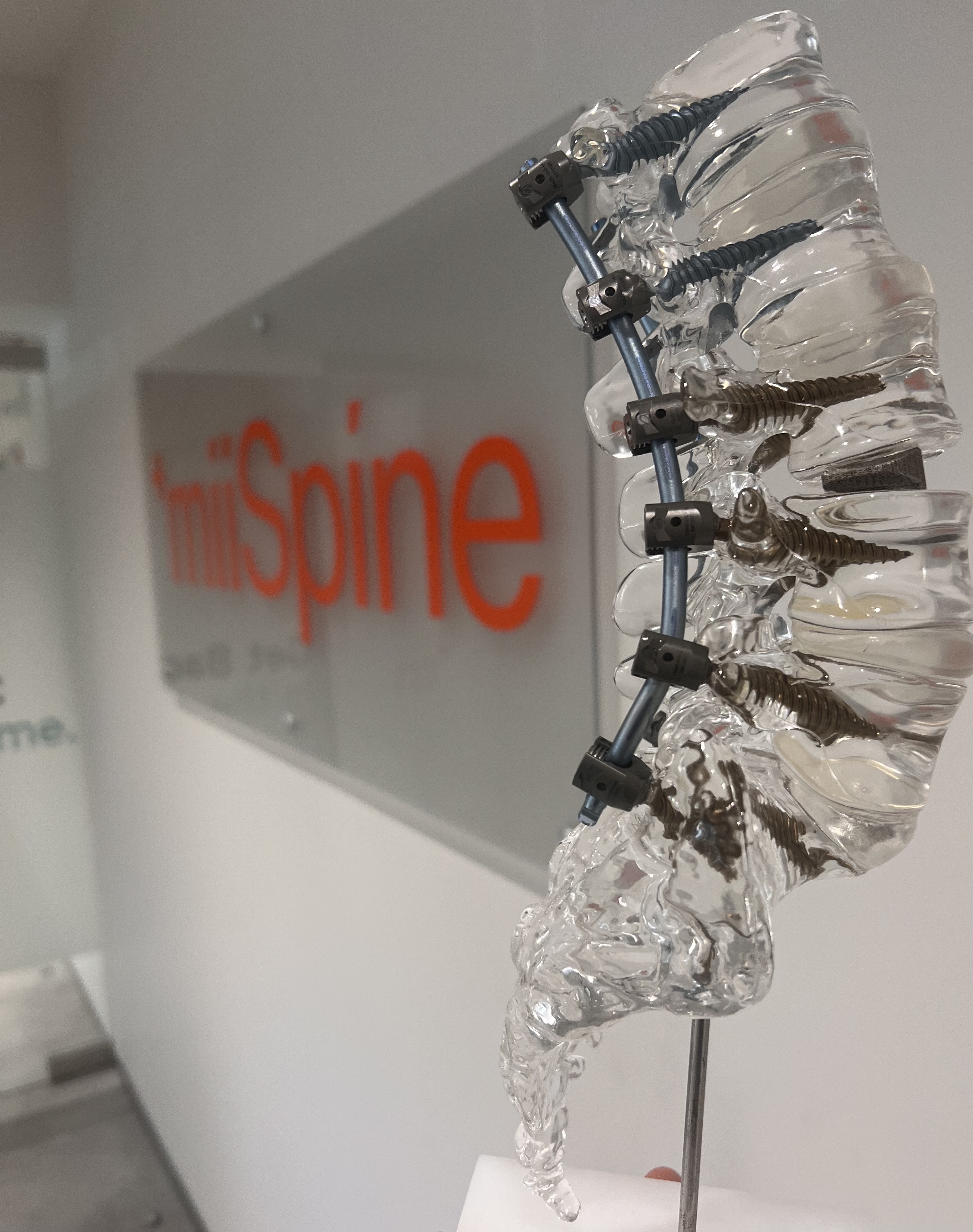
Your lower back is a stack of bones with discs between them. When one bone slips forward on the one below it (spondylolisthesis), or a worn disc lets a level move in ways it shouldn't, that movement can hurt and can pinch the nerves. A fusion removes the worn disc, puts a small cage filled with bone graft in its place, and holds the two bones still with screws until they grow together into one solid bone. The version Dr. Vemuri uses is called MIS TLIF: minimally invasive transforaminal lumbar interbody fusion. The long name means the work is done through small openings from the side of the spine, with the back muscles moved aside rather than cut.

Inside the miiSpine clinic in Louisville

How the surgery goes.

Small openings, muscle moved aside

Dr. Vemuri works through narrow tubes placed between the muscle fibers. The big back muscles aren't stripped off the bone, which is the main reason this hurts less than open fusion.

The disc comes out, the nerve is freed

The worn disc is removed and anything pressing on the nerve is cleared. A cage packed with bone graft goes into the disc space to hold its height.

Screws hold the level while it heals

Screws placed through the skin hold the two bones still. Dr. Vemuri uses the Invictus system he helped develop with ATEC Spine, designed to shorten surgery time and X-ray exposure.

When fusion makes sense, and when it doesn't.

Most back pain never needs a fusion. Therapy, medication, injections and time come first, and a lot of people get better with those. Fusion is for a specific problem: a level that is unstable, a bone that has slipped, a disc that has herniated again after a previous surgery, or stenosis with instability, when conservative care has been given a fair try and hasn't worked. Dr. Vemuri looks at your imaging with you and tells you which of those applies. If a smaller operation will do the job, or no operation at all, he'll say so.

Dr. V on fusion

“Fusion is the biggest tool in the box, so it’s the last one I reach for. When it is the right call, I make it as small as I can.”

What to expect.

Before

A visit with Dr. Vemuri, your MRI and X-rays reviewed with you in the room, and a plain answer on whether fusion fits. If you've been told you need fusion elsewhere, bring that recommendation.

The day of surgery

Many single-level fusions at miiSpine are outpatient or a single night. You're up and walking before you leave.

After

A written plan for walking, lifting, driving and work, and follow-up X-rays to watch the bone fuse. Bone takes months to join, and the pace is different for everyone, so the plan is yours.

5,000+
Spine surgeries
4,000+
Office visits per year
1,000+
Outpatient spine surgeries

Dr Venu
Vemuri

Dr. Venu Vemuri, D.O. (Dr. V) is a fellowship-trained spine surgeon and is board-certified by the American Osteopathic Board of Orthopedic Surgery. He opened miiSpine in 2021 as an independent alternative to corporate medicine. He has performed more than 5,000 spine surgeries, has done minimally invasive spine surgery, including fusions, in ambulatory surgery centers since 2014, collaborated with ATEC Spine on the Invictus MIS pedicle screw system, and does your fusion himself, start to finish.

View More ↗

Questions about lumbar fusion.

What does MIS TLIF mean?

Minimally invasive transforaminal lumbar interbody fusion. In plain terms: the disc is removed and a cage is placed through small openings from the side of the spine, and screws hold the level still while the bone fuses. The back muscles are moved aside, not cut.

How is it different from open fusion?

Open fusion uses one long incision down the middle of the back and strips the muscle off the bone to reach the spine. MIS TLIF reaches the same place through small openings between the muscle fibers. In our experience that means less blood loss, less pain afterward, and a shorter stay.

Is lumbar fusion outpatient surgery?

For many single-level cases, yes. Dr. Vemuri does same-day fusions regularly. Others stay one night. He'll tell you which to expect at your consultation.

How long does recovery take?

Bone takes months to fuse, and everyone heals at a different pace, so we don't promise a date. You'll get a written plan for walking, lifting, driving and work, and follow-up X-rays to confirm the fusion.

What conditions does fusion treat?

A slipped vertebra (spondylolisthesis), a level that moves abnormally with a worn disc, a disc that has herniated again after surgery, and stenosis with instability. Fusion is not a treatment for ordinary back pain.

¿Hablan español?

Sí. Llame al (502) 362-1780, las 24 horas, o visite miispine.com/accidentes.

I've been told I need a fusion. Should I get a second opinion?

Yes, and we're happy to give one. Bring your imaging and the recommendation. Most second opinions at miiSpine don't end in an operation, and if yours does, you'll know exactly why.

Do I need a referral?

No. Call (502) 242-6370 or request an appointment online. Same-week appointments are available.

Does insurance cover lumbar fusion?

Most plans cover it when it's medically necessary. Our team checks your benefits before surgery and tells you what to expect. If you're paying cash, we'll give you the price before you book.

This content is for general information and isn't a substitute for a medical evaluation. Every spine is different. Talk to a spine specialist about your specific symptoms.

Our latest studio
news & insights.

A team of programming experts and designing
professionals develops, design, runs test, and/or manages
software development for the below-written :